Balanced Scorecard
Summary
The Balanced Scorecard translates Mission and Vision Statements into a comprehensive set of objectives and performance measures that can be quantified and appraised. These measures typically include several categories of performance such as financial performance (such as revenues, earnings and return on capital), customer value performance (such as market share and customer satisfaction measures), internal business process performance (such as productivity rates and quality measures), innovation performance (such as percent of revenue from new products and rate of improvement index) and employee performance (such as morale and best demonstrated practices).
Total Quality Management
Many of the Total Quality Management (TQM) concepts originated with the work of Dr. W. Edwards Deming, the American statistician. During World War II he taught American industries how to use statistical methods to improve the quality of military products. After World War II, General MacArthur took 200 scientists and specialists, including Dr. Deming, to Japan to help rebuild the country. Many Japanese manufacturing companies adopted Dr. Deming’s philosophy. Deming’s major philosophy is that quality improvement is achieved through the statistical control of processes and the reduction in variability of these processes. Deming emphasises that management should encourage employee participation and should encourage the employees to use their understanding of the processes and how they can be improved (Munro-Faure and Munro-Faure, 1992, pp 291–292).
Dr. Joseph M. Juran broadened quality from its original statistical origin. He stressed the importance of systems thinking that begins with product designs, prototype testing, proper equipment operations, and accurate process feedback. Juran provided the move from Statistical Process Control to Total Quality Control in Japan. This included company-wide activities and education in quality control, and promotion of quality management principles. By 1968, Kaoru Ishikawa had outlined the elements of Total Quality Control management:
- quality comes first, not short-term profits;
- the customer comes first, not the producer;
- customers are the next process with no organizational barriers;
- decisions are based on facts and data;
- management is participatory and respectful of all employees;
- management is driven by cross-functional committees covering product planning, product design, production planning, purchasing, manufacturing, sales, and distribution (Ishikawa, 1985).
The Scorecard at Analog Devices, Inc.
In 1986 Analog Devices, Inc. (ADI), a mid-sized semiconductor company, hired Art Schneiderman as Vice President of Quality and Productivity Improvement. Schneiderman introduced goals for a series of quality measures that correspond to what he considered to be the critical success factors for ADI (Anthony and Govindarajan, 1997). As part of the five-year strategic plan of ADI, Schneiderman also developed a one page report, called the Scorecard. This scorecard showed three categories of measures: financial, new products and Quality Improvement Process:
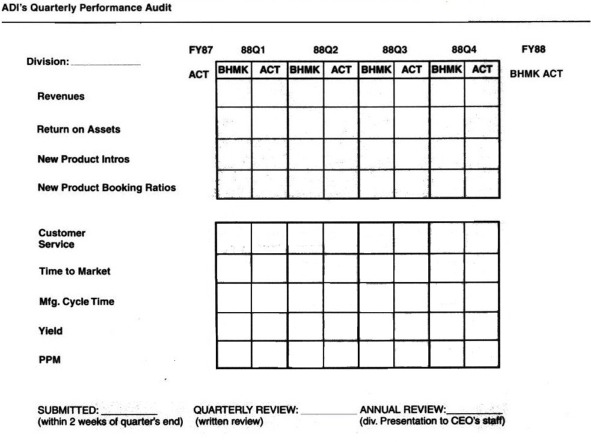
The basic idea in creating this scorecard was to integrate financial and nonfinancial metrics into a single system in which they did not compete with one another for management airtime (Schneiderman, 2001).
The Balanced Scorecard in the 1990s
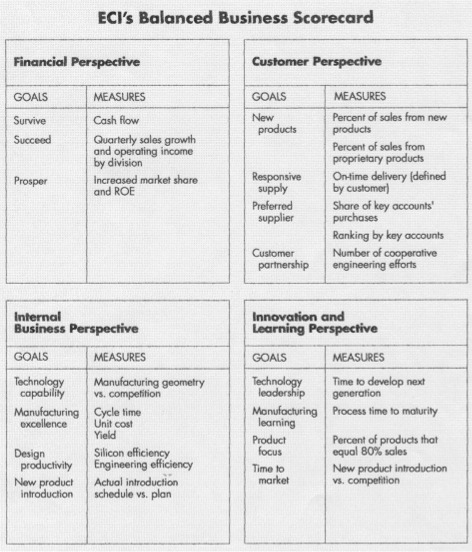
In 1990 Bob Kaplan invited Schneiderman to the Nolan-Norton study group on performance measurement. Bob Kaplan and Schneiderman presented the use of the scorecard at Analog Devices, Inc. During a second Nolan-Norton study the participants implemented scorecards within their organizations. Eric Norton, who served as the project leader and facilitator, and Bob Kaplan wrote up the experiences of the participants with the scorecard and devised a “balanced scorecard” in 1992. This balanced scorecard supplemented traditional financial measures with criteria that measured performance from the perspective of customers, internal business processes and innovation and learning. When using the balanced scorecard, companies articulate goals for each perspective and translate these goals into specific measures. An example (Kaplan and Norton, 1992):
The Balanced Scorecard as a Strategic Management System
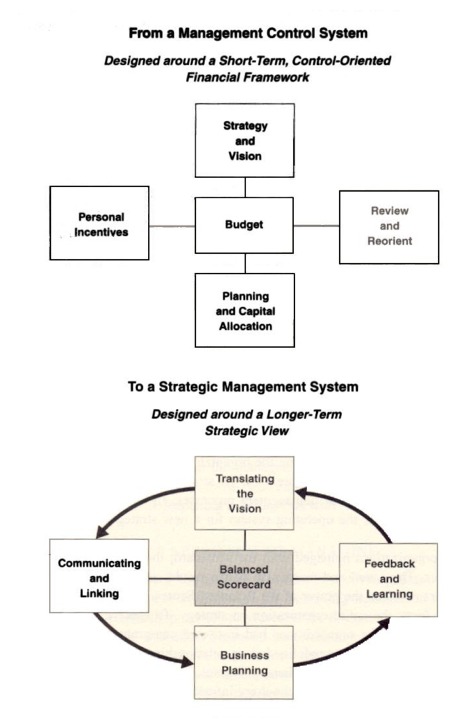
In 1996 Kaplan and Norton argued that the balanced scorecard could be used as a strategic management system which supports four management processes (Kaplan and Norton, 1996):
- Translating the Vision: Lofty statements such as “becoming the number one supplier” or “best in class” are difficult to translate into operational measures that have meaning to the people at the local level. Creating a balanced scorecard however forces management to further clarify their vision until they are able to translate the vision into a set of objectives and operational measures on the balanced scorecard, which have meaning to the people who have to realize the vision. These objectives and measures for the four perspectives, agreed upon by all executives, describe the long term drivers of success.
- Communicating and Linking: Implementing a strategy begins with communicating the strategy up and down the organization and educating those who have to execute it. The strategy must also be translated into goals and performance measures on the balanced scorecard for operating units and individuals. Rewards might be linked to these performance measures.
- Business Planning: Managers set targets for the long term objectives for all four scorecard perspectives. In order to achieve these long term objectives, managers identify the strategic initiatives required and allocate the necessary resources to those initiatives. Finally, managers establish short term goals (milestones) for the measures that mark progress towards achieving the long term objectives.
- Feedback and Learning: Managers formulate a strategy based on certain hypotheses about cause-and-effect relationships. Examples of hypotheses:
- a higher customer satisfaction (a measure in the customer perspective) is correlated with faster payments of invoices (a measure in the financial perspective) and faster payments result in a higher return on capital (another measure in the financial perspective);
- improved information systems (a measure in the internal business processes perspective) result in higher sales (a measure in the financial perspective).
According to Kaplan and Norton, companies should use the balanced scorecard as the center for management processes, instead of budgets (Kaplan and Norton, 2001 pp. 22–26):
Advantages and Disadvantages of the Balanced Scorecard
The advantage of the balanced scorecard is breadth. By combining financial measures with measures of customers, internal processes and innovation, it prevents managers from focusing on short-term financial results alone and helps to translate strategy into concrete, measurable objectives.
The balanced scorecard also has a number of well-known disadvantages:
- It can become complex and unbalanced. Organizations often end up with too many measures, which makes the scorecard hard to maintain and dilutes management attention.
- The cause-and-effect links are assumed. The scorecard relies on hypothesised relationships between perspectives — for example, that higher customer satisfaction leads to higher returns — that are not always confirmed in practice.
- It is demanding to implement. Designing, populating and maintaining a balanced scorecard is time-consuming and requires sustained commitment from senior management.
- It measures performance, not capacity. The balanced scorecard reports how the organization is performing across several perspectives, but it does not identify which stage in the production-and-sales process limits its output, sales and profit.
In short, the main disadvantages of the balanced scorecard are that it can grow too complex and unbalanced, and that its assumed cause-and-effect links between the perspectives may not hold in practice.
Bibliography
- Anthony, R. N. and V. Govindarajan, “Management Control System, 9th Ed.”, McGraw-Hill Professional Publishing, January 1997, Case 11-1.
- Ishikawa, Kaoru. ‘What Is Total Quality Control? The Japanese Way.’ Englewood Cliffs, NJ: Prentice-Hall, 1985.
- Kaplan, R. S., D. P. Norton, ‘The Balanced Scorecard — Measures that Drive Performance’, Harvard Business Review, January–February 1992.
- Kaplan, R. S. and D. P. Norton, ‘Using the Balanced Scorecard as a Strategic Management System’, Harvard Business Review, January–February 1996.
- Kaplan, R. S. and D. P. Norton, ‘The Strategy Focused Organization’, Harvard Business School Press, 2001.
- Munro-Faure, L. and M. Munro-Faure, ‘Implementing Total Quality Management’, The Free Press, 1992.
- Schneiderman, A. ‘The first Balanced Scorecard: Analog Devices, 1986–1988’, Journal of Cost Management, September/October 2001.